Is Time Management Ruining Your Leadership? (And What to Do About It)
Aug 25, 2026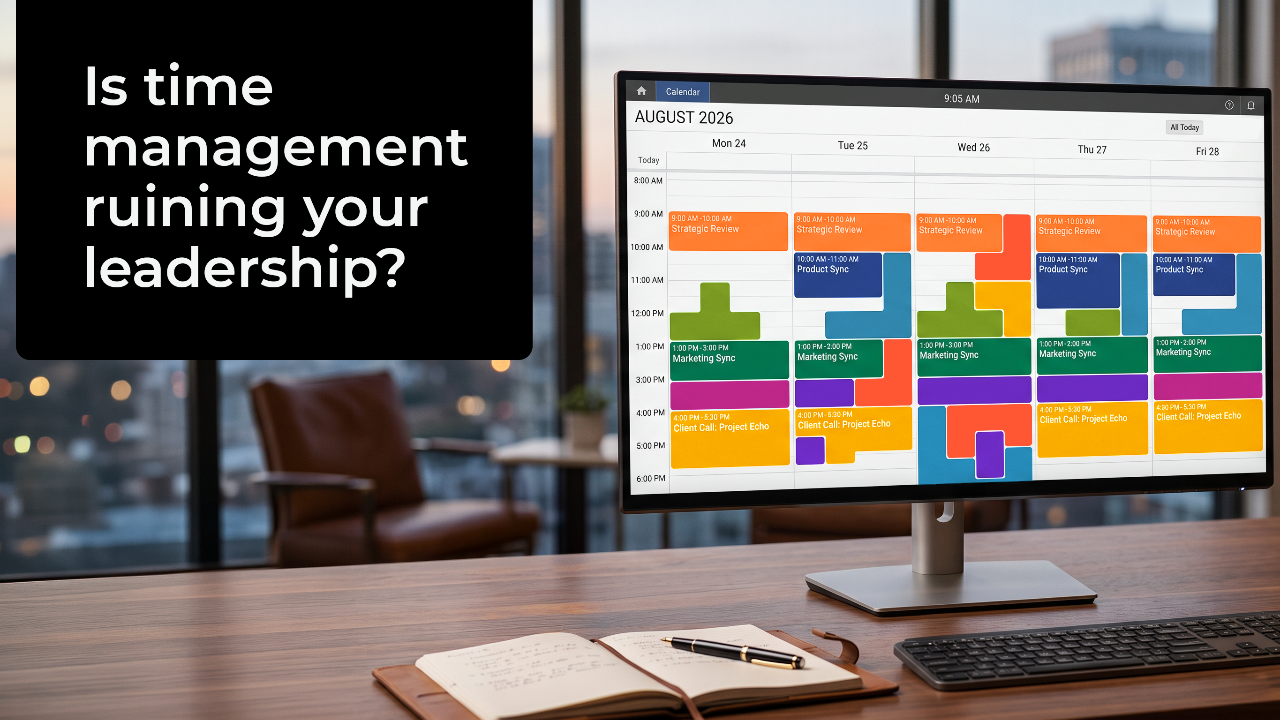
Look at your calendar for the coming week. If it looks like a game of high-stakes Tetris (interlocking, back-to-back blocks stretching from 8:00 AM to 6:00 PM) you are not alone.
For decades, the standard corporate playbook has preached the gospel of time management. We buy planner apps, adopt time-blocking systems, and squeeze fifteen-minute check-ins into previously open gaps. We operate under the flawed assumption that if we can just manage our hours more efficiently, we will achieve peak leadership performance.
Yet, despite meticulously optimized schedules, leaders everywhere are hitting an invisible wall. By 2:00 PM, strategic thinking feels like wading through wet cement. Small frustrations spark outsized reactions. Decisions take twice as long to make, and evening hours are spent in a haze of mental exhaustion.
Here is the truth: Time is not your most critical resource. Energy is.
Time is fixed, linear, and non-renewable; everyone gets the exact same 24 hours. Energy, however, is dynamic and renewable. A 60-minute meeting led with depleted mental energy produces confusion, friction, and half-baked decisions. That same 60 minutes led with high cognitive clarity, emotional composure, and presence can align a team for months.
To lead sustainably in high-velocity environments, we must shift our paradigm from managing clock time to mastering our energy.
The Brain on Empty: The Physiology of Cognitive Depletion
To understand why traditional time management fails, we have to look inside the brain. The prefrontal cortex (PFC) handles key leadership functions: complex problem-solving, strategic foresight, emotional regulation, empathy, and conscious decision-making. While the brain accounts for roughly 2% of our total body mass, it consumes approximately 20% of our daily glucose and metabolic energy. The PFC is the most metabolically expensive real estate in the entire human body.
Every time you make a decision, inhibit an impulse, resolve a conflict, or switch between tasks, your prefrontal cortex burns through neurochemical fuel.
When your cognitive energy is depleted, the brain shifts into energy-conservation mode:
🪫Decision Fatigue Takes Over: The brain defaults to shortcuts, biases, or procrastination. You become either overly risk-averse or impulsively reckless.
🪫The Amygdala Hijacks Executive Function: Depleted energy impairs your ability to regulate emotions. The brain’s threat-detection circuitry becomes hyper-vigilant, interpreting ambiguity as a threat and reacting with irritation or defensiveness.
🪫Empathy Drops: Perspective-taking requires substantial cognitive bandwidth. When energy is low, our neurological capacity to listen deeply and support others is among the first casualties.
When you lead on empty, you aren't just tired: your brain is biologically compromised.
The Four Aspects of Leadership Energy
Sustainable leadership requires tending to four interconnected energy reservoirs:
1. Physical Energy: This is your foundational fuel tank: sleep quality, nutrition, hydration, and movement. Without physiological capacity, mental agility is impossible. Sleep, in particular, is non-negotiable; during deep sleep, the brain’s glymphatic system clears metabolic waste (including beta-amyloid plaques) that accumulates during waking hours.
2. Emotional Energy: Emotions are contagious. Neuroscience demonstrates that leaders unconsciously transmit their internal emotional climate to their teams through mirror neurons and non-verbal cues. Operating in chronic frustration or anxiety spreads a threat state across your entire department, while calm and grounded composure fosters psychological safety.
3. Mental Energy: Mental energy relates to where and how you direct your attention. The brain cannot multitask; what we call multitasking is actually rapid context-switching, which incurs a heavy metabolic penalty and leaves behind "attention residue." Protecting your mental energy means protecting your focus.
4. Purposeful Energy: Purpose provides intrinsic motivation. When leaders and teams connect their daily tasks to meaningful outcomes, the brain releases dopamine: a neurotransmitter that creates feelings of satisfaction and enhances drive, stamina, and resilience.
How to Optimize Your Leadership Energy
Shifting from time management to energy management doesn’t require overhauling your entire life. It starts with small, intentional adjustments to how you structure your day. When you align your work habits with how your brain naturally operates, you accomplish more with less friction. Here are some brain-friendly practices you can start using this week:
🔋Honor Your Natural Rhythms
Our bodies and brains operate in ultradian cycles, natural rhythms of peak alertness lasting roughly 90 minutes, followed by a brief dip in cognitive efficiency.
Stop scheduling 60-minute back-to-back meetings. Structure work in 60-to-90-minute sprints, followed by 10 minutes of genuine disconnection (step away from screens, take a walk, hydrate).
🔋Protect Peak Cognitive Hours: Because the prefrontal cortex fatigues as the day progresses, your sharpest executive brain power usually exists in the first 2 to 4 hours of your workday. Don't squander your peak cognitive energy on clearing your inbox or attending low-stakes status updates. Reserve your morning "Golden Hours" for high-impact decisions, strategy, and complex problem-solving.
🔋Normalize Active Recovery: Rest is not a reward you earn after burning out; it is an active performance strategy. Introduce micro-recovery rituals into your day. A two-minute breathing exercise shifts your brain from a fight-or-flight state back into high-performance executive functioning.
🔋Audit Your Energy Vampires and Catalysts; Take stock of the activities, interactions, and environments that drain your battery versus those that recharge it. Conduct an Energy Audit. Review your calendar from last week. Mark activities in Red (drained energy without return), Yellow (neutral/maintenance), and Green (energizing/high-impact). Look for opportunities to eliminate, delegate, or reframe the chronic red zones.
The Energy Ripple Effect
Mastering energy over clock time unlocks more than personal performance. It shapes your entire team culture. By demonstrating healthy boundaries, prioritizing recovery, and respecting cognitive limits, you grant everyone around you permission to do the same.
Interested in developing brain-based leadership skills that last? Explore our Certificate in Applied Leadership (CAL) and applied neuroscience programs at eLeadership Academy®.
About eLeadership Academy®
eLeadership Academy is the only online training solution that provides accessible, actionable training to develop high-performance leaders that people love to follow. For more information, visit www.eleadershipacademy.com or contact training@eleadershipacademy.com.